

November 30, 2025
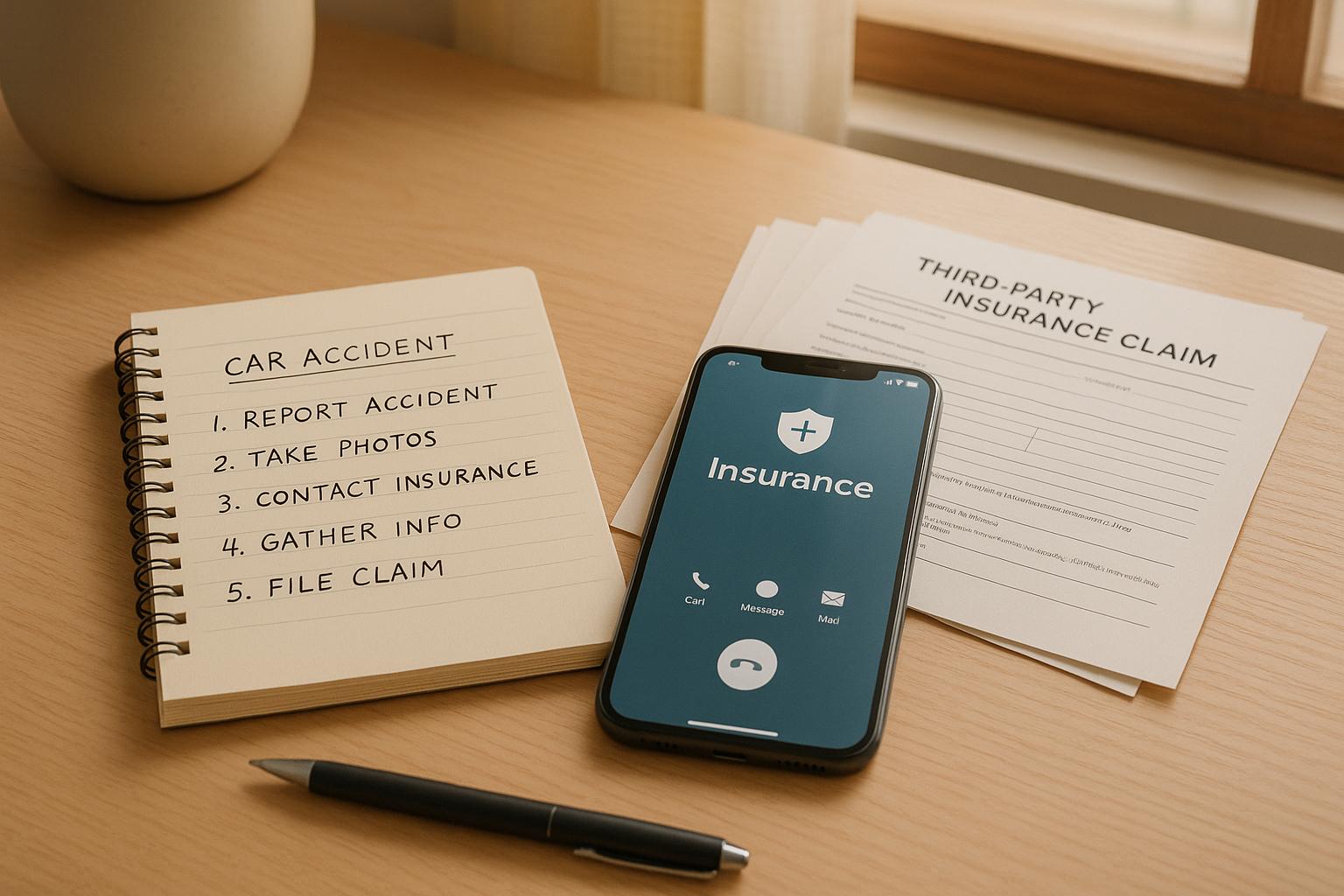
When someone else is responsible for a car accident, you’ll file a third-party insurance claim with their insurer to recover damages. This process can be stressful, but breaking it into clear steps makes it easier. Here’s a quick overview of what you need to do:
Documenting the accident scene right away is crucial for building a strong claim. Missing even small details could weaken your case later, so take the time to gather everything you might need.
Start by collecting the other driver's essential details: their full name, phone number, driver's license number, vehicle registration, insurance provider, and policy number. Make a note of the vehicle's make, model, color, and license plate. If the other driver refuses to cooperate, take a photo of their license plate and vehicle, then contact the police for assistance.
Photographs and detailed notes can be invaluable. Take pictures of the entire scene, including road conditions, vehicle damage from different angles, and the final positions of the vehicles. Record key details like the date, time, location, weather, and lighting conditions. If possible, jot down any statements made by the other driver and gather contact information from witnesses.
If there are injuries, significant property damage, or disagreements about fault, request a police report. This report will include the officer's observations, statements from drivers and witnesses, and any citations issued. Keep all your documentation - photos, notes, and the police report - organized in a secure folder or cloud storage for easy access later.
Contact your insurance company as soon as possible after the accident. Many policies require you to report incidents within a specific timeframe - usually between 24 and 72 hours. Doing this not only keeps you in compliance with your policy but also ensures you can access their guidance throughout the claims process.
Your insurer acts as your partner in navigating the situation. They handle communication with the other driver's insurance company, helping to determine fault and resolve the claim. It's worth noting that your contract with your insurance company obligates them to protect your interests - a level of responsibility you won’t get from the other driver's insurer.
When you call your insurer, be ready to provide key details about the accident. This includes the date, time, and location of the incident, a clear description of what happened, and the contact and insurance information of the other driver. If you have a police report, photos, or witness information, share those as well. Also, describe the damage to your vehicle and any injuries you or your passengers sustained.
This information is essential to building your claim and setting the stage for dealing with the other driver's insurance company.
Your insurance company can often take the lead in filing a claim with the at-fault driver’s insurer, making the process smoother. Ask if they can handle this on your behalf. They can present your case, work to establish fault, and coordinate with the other insurer’s claims adjuster to keep things moving.
Make sure to get the name and contact information of your assigned claims representative. This will make it easier to get answers to your questions and stay informed. Discuss what the third-party claims process will involve, what documents you’ll need, and the expected timelines. Keep your insurer updated about any new developments, like communication from the other driver’s insurer, updated repair estimates, or changes in medical treatment. Respond promptly to requests for additional information.
It’s a good idea to document all your interactions with your insurer. Keeping a record ensures that nothing slips through the cracks, even if you need to repeat information.
Once this step is complete, you’ll be ready to submit your claim to the at-fault driver’s insurer and move forward in the process.
Once you've informed your own insurance company, the next step is to file your claim directly with the at-fault driver's insurer. This is where you officially request compensation for your damages. Taking this step gives you direct control over the process and ensures you're communicating with the party responsible for covering your losses.
To make the claims process as smooth as possible, it's crucial to stay organized. Having all your paperwork ready before reaching out can help prevent delays and ensure the insurer has everything they need to evaluate your claim efficiently.
Start by contacting the at-fault driver's insurance provider. Use the policy number from their insurance card, which you should have obtained at the accident scene. If you don’t have it, you can often find the insurer's claims contact information online.
Many insurance companies now offer online portals that make it easier to file and track claims. Setting up an account allows you to upload documents, monitor your claim's progress, and communicate directly with the claims adjuster. This can save time and keep everything in one place.
When you contact the insurer, provide a straightforward account of the accident. Include key details like the date, time, location, and a brief description of what happened. If you have a police report number, share it as well. Be sure to mention the damage to your vehicle and any injuries you sustained.
Stick to the facts. Avoid admitting fault or speculating about who is responsible - it's the insurance company's job to investigate and determine liability. Also, provide your contact details and let them know how you'd prefer to receive updates.
Most insurance companies will acknowledge your claim within 24 to 48 hours. After that, they’ll assign a claims adjuster to your case. The adjuster will review statements, examine photos, analyze police reports, and may even inspect the vehicles involved. This initial investigation phase usually takes one to two weeks, though more complicated cases might require additional time.
Once you've made contact, your next priority is gathering and submitting all the necessary documentation.
After reaching out to the insurer, focus on collecting and organizing the evidence they’ll need to process your claim. Having everything ready to go shows you're serious about resolving the matter quickly and helps avoid unnecessary delays.
Key documents include the police report. This official account of the accident is critical because it provides an independent assessment of what happened, including the responding officer's observations and any citations issued. If you don’t already have a copy, you can request one from the law enforcement agency that handled the incident.
Submit clear, timestamped photos of the accident scene and the damage to your vehicle. Take pictures from multiple angles to provide a complete view. Don't forget to document road conditions, traffic signals, skid marks, debris, or anything else that may have contributed to the crash. These photos serve as unbiased evidence.
You'll also need to provide repair estimates from reputable auto body shops. Getting quotes from multiple shops can be helpful, especially if the insurer's initial offer seems low. If you were injured, include copies of your medical bills and records, as well as receipts for any related expenses like towing, rental cars, or medications.
If there were witnesses, provide their statements along with their contact information. Independent witnesses can support your version of events and help establish fault. Be sure to include the other driver’s full details, such as their name, phone number, driver's license information, vehicle details, and insurance policy number.
In some states, insurers are required to settle claims within a specific timeframe. For instance, in New Jersey, insurance companies have 45 calendar days to resolve a third-party claim once they’ve been notified of the loss.
Keep track of all interactions with the insurance company. Record dates, times, the names of representatives you speak with, and the details of each conversation. This log can be a valuable reference if you need to follow up or address any issues.
If anything is unclear, don’t hesitate to ask questions. Submit your documents through the method the insurer prefers, whether that’s by mail, email, or an online portal.
Once your claim and supporting documents are submitted, the claims adjuster will complete their investigation, determine fault, and assess your damages. This sets the groundwork for the next step: working with the adjuster to resolve your claim.
After submitting your claim and the necessary documents, the at-fault driver's insurance company will assign a claims adjuster to your case. This person becomes your primary contact and plays a key role in determining whether your claim is approved and how much compensation you'll receive. The adjuster’s job is to investigate the accident, review the evidence you've provided, determine fault, and assess the value of your damages.
It's important to understand that the adjuster works for the insurance company, not for you. Their goal is to protect the company's interests, which may mean being cautious with their investigation and not prioritizing the highest possible settlement for you. That said, maintaining a professional and organized approach can help keep the process smooth and demonstrate that your claim is legitimate.
The adjuster will gather information by reviewing statements from both drivers and witnesses, analyzing the police report, examining photos, and evaluating other evidence. Their job is to piece together what happened, determine liability, and verify the extent of your damages before any payments are made.
When the adjuster contacts you, provide clear and honest answers to their questions. Stick to the facts, explain events in order, and avoid exaggeration. Be thorough in describing the damages you’ve suffered and the expenses you’ve incurred.
Keep a detailed record of all interactions with the adjuster. Note dates, names, and a summary of what was discussed. This can be crucial if you need to reference past conversations or resolve disputes later.
Maintain a professional and courteous tone in all your communications. Being cooperative can make it easier for the adjuster to work with you and helps avoid unnecessary conflict that could delay your claim. If you’re unsure about any of their questions or requests, don’t hesitate to ask for clarification. It’s better to get things right the first time than to risk delays caused by incomplete or incorrect information.
Once clear communication is established, be prompt in providing any additional information the adjuster requests.
Even after submitting your initial documents, the adjuster may need more information as they continue their review. They might ask for additional records, such as medical reports, receipts for expenses, repair estimates, or proof of lost wages. Being organized and having these documents readily available will help you respond quickly to their requests.
Timely responses are key to keeping the process moving. Keep copies of everything you send and note the dates you submitted them. This makes it easier to track what has been provided and can help resolve any questions that arise later.
Only provide information that can be verified. If you’re missing any requested documents, explain why and offer alternative evidence if possible. The goal is to show a good-faith effort to support your claim while being transparent about any limitations.
Once the adjuster completes their investigation, they’ll determine fault and provide an initial estimate of repair costs. If the other driver is found fully at fault, their insurance company will either send you a check for the repairs or pay the body shop directly, up to the limits of their policy. If fault is shared, the payment will be adjusted based on the percentage of fault assigned to each party.
This investigation process leads directly into the next step, where you'll evaluate the settlement offer and decide on your next course of action.
Once the adjuster determines fault, the at-fault insurer will present a settlement offer. This could come in the form of a check or direct payment to your repair shop. In the U.S., insurers generally have 45 calendar days to settle a claim.
The settlement should cover all documented damages, including repair costs, medical bills, lost wages, and any other out-of-pocket expenses. However, initial offers might not fully address your actual costs. Compare the offer to your documented expenses to decide whether to accept it or push for a higher amount.
Using the documentation you've organized from earlier steps, carefully compare the insurer's offer to your verified expenses. This includes repair estimates from reliable shops, medical bills, receipts for transportation or rental cars, and proof of lost wages. If the settlement seems significantly lower than your actual costs, ask for a detailed explanation of how the insurer calculated the amount. This breakdown can help you spot any discrepancies or overlooked damage categories - such as if the insurer based the settlement on the lowest repair estimate despite multiple competitive quotes.
To strengthen your position, organize your documentation in a clear, itemized format. Include repair quotes, detailed medical records (covering both emergency and follow-up care), and receipts for all related expenses. A well-prepared summary can make a strong case if you need to challenge the offer.
If the settlement falls short, submit a concise written dispute supported by itemized evidence. Certified repair estimates that meet OEM standards can establish a fair market value for repairs. For instance, Red River Collision Center works with insurers to streamline claims and provides detailed repair estimates to back fair settlements.
This step lays the groundwork for further action if the settlement remains unsatisfactory.
If your claim is denied, the offer is unreasonably low, or you're dealing with serious injuries, consulting an attorney may be the next step. Cases involving significant injuries, permanent disabilities, or fatalities can be more complicated and often require legal expertise.
In no-fault states like New York, seeking compensation for pain and suffering might involve filing a third-party claim, which makes legal guidance especially helpful. Additionally, if the insurer is unresponsive, delays the process, or disputes liability among multiple parties, an attorney can help protect your interests.
Take advantage of free consultations to assess your case. Bring all relevant documentation, such as the police report, medical records, repair estimates, photographs, and any correspondence with the insurance company. Keep in mind that litigation can be time-consuming and may not always be the best option unless negotiations fail. If you decide to pursue legal action, your attorney will guide you through depositions and court proceedings.
If the at-fault driver lacks sufficient insurance or has no insurance at all, your own uninsured or underinsured motorist coverage may help cover damages not addressed by the third-party claim.
Next, we’ll dive into what your third-party insurance might cover. Stay tuned.
Third-party insurance typically covers two main types of damages: bodily injury and property damage. Understanding these categories can help you know what to expect.
Bodily injury coverage takes care of medical expenses resulting from the accident. This can include costs like hospital bills, emergency room visits, rehabilitation, prescription medications, ongoing treatments, and even lost wages if your injuries prevent you from working.
Property damage coverage, on the other hand, addresses damage to your vehicle and personal belongings. This might include repair costs to restore your car to its previous condition or replacement costs if your vehicle is declared a total loss.
In addition to these basics, third-party insurance may also cover rental car expenses while your vehicle is being repaired. To get reimbursed, you’ll need to provide receipts that document the rental period and daily rate. Insurance companies usually cover reasonable rental costs that match your vehicle type. These details highlight the importance of understanding your policy limits and any potential gaps in coverage.
However, coverage is limited by the at-fault driver's policy limits. If the damages exceed their policy’s maximum payout, you may face a shortfall. In such cases, your own underinsured motorist coverage could step in to cover the difference. If you don’t have this coverage, you might need to seek compensation directly from the at-fault driver, which can be a challenging process.
State laws also play a role in defining what third-party insurance covers. In at-fault states, you can claim both bodily injury and property damage. But in no-fault states, claims typically focus on property damage, as medical expenses are covered by Personal Injury Protection (PIP) regardless of fault. Some no-fault states allow claims for pain and suffering, but only if injuries meet specific thresholds, such as permanent disability or disfigurement.
If the at-fault driver is uninsured or underinsured, your options for compensation may be limited. Without an insurance company to handle the claim, you might need to pursue the at-fault driver directly, which can be difficult. This is where your own uninsured motorist coverage becomes essential.
For vehicle repairs, working with a certified repair shop can make the claims process smoother. A shop like Red River Collision Center collaborates directly with insurance companies, providing detailed repair estimates that meet OEM standards. Their certified technicians document all necessary repairs, ensuring that your property damage claim is supported and processed efficiently.
Finally, thorough documentation is crucial throughout the claims process. Proper records not only support your settlement offer but also ensure that every expense is tied directly to the accident. Keep in mind that third-party insurance only covers damages related to the incident. Pre-existing vehicle issues or unrelated medical conditions won’t be included, so it’s important to clearly connect all claimed expenses to the accident.
After filing your third-party claim, the next important step is picking a collision repair shop that aligns with both your repair expectations and insurance requirements. The shop you choose plays a big role in determining the quality of repairs and how smoothly your claim is processed. In short, this decision ensures that everything - from your claim paperwork to the actual repairs - is handled seamlessly.
Many collision repair shops have partnerships with insurance companies, making the claims process much simpler for you. These shops often have established workflows that allow them to communicate directly with the insurance adjuster assigned to your claim. This helps avoid delays and ensures that repairs stay within the insurer’s approved budget.
Here’s how it typically works: the repair shop reviews the adjuster’s estimate, conducts its own detailed damage assessment, and coordinates the repair timeline with the insurer. If any issues arise - such as disagreements over labor costs, parts quality, or additional damages uncovered during repairs - a skilled repair shop will handle these discussions directly with the adjuster to resolve them.
For example, Red River Collision Center offers a full range of collision repair services, including paintless dent repair, custom car painting, and certified auto body repair that meets OEM (Original Equipment Manufacturer) standards. They also provide a limited lifetime warranty on their repairs and work closely with insurance companies to ensure a hassle-free process.
"Our insurance partnerships and expert staff ensure a smooth, efficient repair process. We back our work with a limited lifetime warranty for as long as you own your vehicle, giving you confidence that your repairs are completed with the highest level of craftsmanship." - Red River Collision Center
Some repair shops also assist with cost coordination. If repair expenses exceed the insurer’s approved amount, they may offer solutions such as payment plans or financing options to help bridge the gap.
Choosing a certified repair shop that offers warranties is a smart move. Warranties protect you from potential issues down the road, and certified shops that follow OEM standards ensure your vehicle is repaired to the manufacturer’s specifications. This means using the right tools, adhering to strict repair processes, and using OEM parts, all of which help maintain your car’s safety, durability, and value. These standards are often required for insurance approvals, too.
At Red River Collision Center, I-CAR-trained technicians follow precise OEM repair guidelines, offering services like paintless dent repair, custom car painting, and certified auto body repair - all in one location. This integrated approach not only simplifies the repair process but also eliminates the need to visit multiple shops.
When comparing repair shops for your third-party claim, ask about their certifications, warranty coverage (including what’s included and how long it lasts), and their experience working with your specific insurer. A trustworthy shop will provide transparent pricing and keep you informed about any additional repairs or adjustments that could impact the final cost. By focusing on these factors, you can ensure your vehicle is restored to its original condition and your claim is handled efficiently.
Filing a third-party claim becomes much more manageable when you follow a clear set of steps. The five steps covered in this guide - gathering information at the accident scene, notifying your insurance company, submitting your claim to the at-fault driver's insurer, working with the claims adjuster, and reviewing the settlement offer - serve as a practical roadmap for what might otherwise seem like an overwhelming process.
Staying organized is crucial throughout the entire process, from documenting the accident to reviewing the settlement. Keep thorough records to protect your claim. This includes saving police reports, medical records, repair estimates, and all correspondence with insurance companies. Also, track claim numbers, adjuster contact details, and dates of conversations. Having everything documented ensures you’re prepared to provide additional information if needed.
Acting quickly is just as important. Filing your claim promptly helps preserve evidence, ensures witness accounts remain accurate, and secures clear medical documentation. Starting the process sooner means you can address repairs faster and get back to your regular routine.
Once your claim is resolved, the quality of your vehicle repairs becomes the next priority. Choosing the right collision repair shop makes a big difference. Opting for a shop like Red River Collision Center simplifies the process. They not only handle insurance requirements but also ensure repairs meet OEM standards and come with a limited lifetime warranty. By selecting a repair center that prioritizes quality and understands the claims process, you can avoid unnecessary stress and trust that your vehicle will be restored properly.
If the at-fault driver's insurance denies your claim or comes back with a settlement that feels too low, take a deep breath and don’t rush into any decisions. Start by carefully reviewing the denial notice or settlement offer to understand their reasoning. It might be something you can address by supplying more evidence, like photos of the damage, statements from witnesses, or detailed repair estimates.
If the problem isn’t resolved after providing additional information, it may be time to seek advice from a legal professional or an insurance claims expert. These professionals can help you navigate negotiations with the insurance company or guide you on whether filing a lawsuit is the right move. Staying calm and keeping your documentation in order will go a long way in working toward a fair outcome.
Red River Collision Center works hand-in-hand with insurance companies to simplify the claims process, aiming to make it as smooth as possible for you. Their team of certified technicians ensures all repairs meet OEM standards, bringing your vehicle back to its pre-accident condition. To top it off, they offer a limited lifetime warranty on their work, giving you extra confidence in the quality of their service.
If the driver at fault doesn’t have insurance or their coverage falls short of covering your damages, you still have a few paths to consider. Start by reviewing your own insurance policy to see if you have uninsured/underinsured motorist coverage. This type of coverage is specifically designed to step in during situations like these, helping to cover any remaining costs.
If your policy doesn’t include this coverage, you may need to pay out of pocket or consider pursuing legal action to recover damages directly from the at-fault driver. It’s always wise to reach out to your insurance provider for guidance on the best course of action. When it comes to repairing your vehicle, a reliable repair center like Red River Collision Center can restore it to its original condition. They’ll even work directly with your insurance company to make the process as smooth as possible.
